Ai and Copyright.
One of the most absurd accusations in the crusade against AI is that it “steals” the content it uses for training. And the even more absurd thing is that, in order to work, this narrative desperately needs to lean on the notion of copyright. Without that conceptual crutch, in fact, the word “theft” would immediately begin to creak.
Theft, in the ordinary sense of the word, assumes that the victim is deprived of the stolen good. If I steal your bicycle, you no longer have the bicycle. It is simple enough. But if, instead, we are talking about making a copy of it, then the problem changes in nature: apparently I have your bicycle, but you still have yours too.
At that point we are no longer in the intuitive world of theft, but in a much stranger territory, where the harm does not consist in the physical loss of the object, but in reproduction, circulation, use, or in the loss of control over what has been copied.
To overcome this paradox of the copy, which becomes truly explosive with the invention of printing, the path that leads to copyright was long, complex and, in some respects, accidental. It was not born as an eternal truth carved in stone, nor as a moral principle obvious to every human civilization.
It was born inside a specific technological, economic and political history: the history of the mechanical reproducibility of texts, of publishers, printing privileges, monopolies, censorship and the market.
In short, everything begins with Gutenberg. Or rather: everything changes with Gutenberg. Because before him, copying a book was an almost noble activity, and for a very simple reason: books were constantly at risk of disappearing. It was enough for the few existing copies to be lost, enough for there to be a fire, a war, a sacked monastery, an abandoned library, and entire pieces of culture could vanish forever.
In that world, making a copy did not mean “stealing” something. Very often, it meant saving it.
And copying a book was not exactly like pressing Ctrl-C and Ctrl-V while drinking a coffee. To make a copy, one needed long, tiring, slow, specialized work. The copyist himself, to avoid mistakes, carried out continuous checks: on every page, and often on every line, he performed a kind of textual proof, thanks to which errors would emerge — or at least some of them.
Because copying by hand does not simply mean “rewriting”: it means preserving fidelity, defending continuity, preventing a sentence from changing meaning, a word from being deformed, a concept from being lost in the passage from one hand to another. Making sure that the eyes of needles do not become gutters. (cit.)
And since copying was done by hand, using a pen and ink, you can easily understand that it was a long, difficult and, precisely, noble job. Have I already mentioned illuminations? Because often it was not even a matter of producing a mere container for text: the copied book could also become an artistic object, decorated, annotated, embellished. A cultural artifact, not a simple medium. Very often, art.
Before Gutenberg, no one, not even the greediest authors, would ever have seriously questioned the nobility and necessity of the copying process. Copying was the way knowledge survived. It was the way a text crossed the centuries. It was the way a civilization prevented itself from forgetting.
Indeed, it is possible to observe, materially, that great civilizations all develop around great libraries, archives, scriptoria, and more generally around the great areas where exchange — including the exchange of ideas — is easier. Where books circulate, concepts circulate. Where concepts circulate, techniques, memories, disputes, heresies, schools and interpretations accumulate. And where all this happens, sooner or later, something resembling a civilization is born.
What happens, then, after Gutenberg?
Something quite predictable happens: with the arrival of a new trade, that of the “printers”, the first reaction is the classic one for the period. A guild, or corporation, or craft association is born, depending on how the corporate concept was implemented in that place and at that time.
Once it has been established that Joseph belongs to the printers’ corporation, it is decided what taxes Joseph must pay, what rules he must follow, what privileges he may have, and how his relationship with the author of the book he intends to print must work. The supply chain, if you prefer.
So far, nothing particularly strange. It was the normal way in which societies of the time tried to frame a new economic activity: it was placed inside a category, regulated, taxed, controlled. If someone produces shoes, he enters the world of shoemakers. If someone works iron, he enters the world of blacksmiths. If someone prints books, he will enter the world of printers. It almost sounds easy.
The problem, however, was that authors were not so easy to find. Sometimes they were far away. Sometimes they had been dead for centuries. Sometimes it was not even entirely clear who the real author of a text was, or which was the “correct” version of the work. Or who the heirs were who had the “rights” to be paid for the book. And so the problem of making a remunerative contract with the author became, for the time, an excessively complex matter.
The initial idea, roughly speaking, was simple: if there is a corporation, or a guild, of printers, then authors need only be paid a certain amount in exchange for the printing of a certain number of copies. After all, that was how things worked in the supply chains of other guilds. There are those who produce, those who transform, those who sell, those who are paid for their contribution. Why should books have been any different?
For one simple reason: books were different.
Because paying royalties to Aristotle, in 1500, was “a bit complicated”. And not only to Aristotle: the same applied to Plato, Cicero, Ovid, Virgil, Euclid, Augustine, Thomas Aquinas, and to that boundless mass of ancient, medieval, anonymous, attributed, translated, copied, recopied and badly recopied authors. There was no office where one could show up, sign a form, pay a royalty and go home with permission to print the Nicomachean Ethics.
And this is where the modern problem of the copy begins: no longer the copy as the salvation of the text, but the copy as an organized, repeatable, taxable, sellable and, above all, controllable economic activity.
To solve the problem — which elsewhere, given that printing also existed in China and in the Arab world, had been addressed with other tools, other customs and other balances — Europe slowly began to build a new concept. Not immediately, not clearly, not with a legislator waking up one morning and saying: “let us invent copyright”. As always, things are born dirty first: practical, administrative, fiscal, corporate.
Then the philosophers arrive, and explain to us that actually it was all very profound.
At the beginning, in fact, the problem was very material: who can print what? With what licence? Paying what taxes? Under what political or religious control? Who is entitled to the privilege of printing a certain book, in a certain city, for a certain number of years? This was the practical level of the matter. Not yet “the soul of the author”. Much more trivially: presses, paper, ink, workshops, censors, privileges, competition and money.
But then the matter becomes more complicated, because in the meantime the figure of the author also changes. The old system of patronage begins to decline. The writer who lives because a prince, a bishop, a court or an aristocrat decides to support him does not suddenly disappear, of course. History does not work by flipping switches. But slowly, alongside the world of the patron, the world of the publishing market grows.
The author no longer writes only to please the lord who hosts him, protects him and perhaps pays for his wine. He also begins to write for an anonymous, dispersed, paying public. And at that point a very modern question is born: if the writer no longer lives from the favour of the powerful, what does he live on?
Here copyright becomes one possible answer.
To justify it, however, something more elegant had to be invented than the simple statement that “publishers want a temporary monopoly on printing”. And indeed the great philosophical rationalizations arrive. Locke, for example, had built a theory of property founded on labour: if I mix my labour with something, that something becomes mine, at least within certain limits.
The theory was born for material property, for land, for physical labour, but it was almost inevitable that someone would try to apply it to mental labour as well. If the farmer can claim the fruit of his labour on the land, why should the author not claim the fruit of his intellectual labour?
Then come Kant and Fichte, and here the matter becomes even more interesting. Kant, in his text against unauthorized reprinting, does not reason exactly like a modern real-estate owner of an idea. For him, the book is not merely a material object sold on the market: it is also a discourse addressed by the author to the public.
Unauthorized reprinting therefore becomes problematic not only because someone “takes a thing”, but because someone abusively places himself between the author and his public, speaking commercially in his place.
Fichte pushes the reasoning even further, distinguishing between the material support of the book, the content of the ideas, and the individual form in which those ideas are expressed. It is precisely this form, this specific way of ordering, presenting and articulating thought, that remains bound to the author. It is no longer just paper. It is no longer just information. It is the way in which a mind has given shape to something.
And so the book progressively becomes a spiritual extension of the author. It does not belong to him as his shoes, his cloak or his house belong to him. It belongs to him in a subtler, more abstract, more metaphysical way: as an expression of his mind, his labour, his personality, his voice.
From this arises the idea that the author has a “right of copy”. A right no longer connected only to the fact that Joseph is enrolled in the printers’ corporation, has paid the required taxes and owns a functioning press, but connected to the work itself and to the relationship between that work and the person who created it.
At that point the problem changes level completely. It is no longer merely a matter of regulating a trade, that is, establishing who may print, with what tools, paying what taxes and respecting what corporate rules. It becomes a matter of regulating the reproduction of a content, regardless of the concrete copyist, his workshop, his guild, his licence and his membership of a corporation.
In other words, the copy ceases to be only a material activity and becomes a legal category. And this is the truly strange part: instead of simply saying “this printer may print and that one may not”, people begin to say “this work has a holder of the right of copy”. Control no longer passes only through the trade of the printer, but through an abstract property over the work.
And this is where the matter becomes peculiar. Because in order to solve a very practical problem — who may print what, who collects, who pays, who controls the market of copies, how the author survives when patronage is no longer enough — a much more ambitious notion is constructed: the idea that the work belongs to the author as a projection of his person, and that this belonging can be separated from the physical object, sold, granted, limited, inherited, regulated.
An ingenious solution, certainly. But also a historically very specific solution. Not a natural law. Not an obvious truth. A construction.
Let us be clear: things did not have to go this way.
Copyright, or something resembling it, was not written in the laws of physics. It was not the only possible answer to the problem of the copy. It was a historical answer, born within a certain technical, economic and political environment.
It went this way for many reasons: movable type printing, the birth of the publishing market, the decline of patronage, the emergence of the professional author, the need for publishers to protect their investments, the need of states to control the circulation of texts, and then also the international, imperial and colonial dimension of the problem.
Because as soon as books begin to circulate beyond borders, the matter immediately becomes more complicated. It is one thing to print a book in your own city, under the eyes of your prince, your bishop, your corporation and your censor. It is another thing to manage the American reprint of a French book, or the English translation of a German author, or the colonial circulation of texts produced in the metropolis. For a famous author, perhaps, some agreement could even be found.
For a small author, on the other hand, enforcing his rights on the other side of the ocean could become an enormous task, that is, essentially impossible.
And indeed modern copyright becomes truly powerful when it ceases to be only a local matter and becomes an international matter. It is no longer enough to say: “this printer has the privilege of printing this book in this city”. One must begin to say: “this work has a rights holder recognized elsewhere too”.
And “elsewhere”, as it happens, often means within a system of empires, colonies, treaties, dominant languages, dominant publishers and states capable of imposing their own legal categories even outside their own home.
But other worlds followed other approaches.
In China, for example, printing existed long before Gutenberg. There were reproduction techniques, book markets, publishers, reprints, state controls, even practices that today we might see as ancestors of protection against unauthorized reprinting. But the modern Western idea did not develop there in the same way: the idea according to which the work is the author’s abstract property, separable from the medium, sellable, transferable, inheritable and defensible as a “right of copy” in the modern sense.
Often, the centre of the problem was not the author as an individual owner of his own expression, but the political, moral, administrative and commercial control of the circulation of texts.
In the Arab and Islamic world, then, the situation was different again. There, the culture of the book had developed for centuries around the manuscript, copying, calligraphy, scholarly transmission, libraries, madrasas, scholars, commentaries, chains of authorization and teaching. The prestige of a text did not depend only on whether someone owned its right of copy, but also on who had transmitted it, copied it, commented on it, studied it, approved it.
The copy was not automatically theft: it could be preservation, study, devotion, transmission of knowledge.
This does not mean that in China or in the Islamic world there reigned some communist paradise of “copy everything for free, brothers”. That would be nonsense. There was power, control, censorship, economic interest, prestige, selective access to texts, religious and political authority.
But the institutional solution was not immediately the modern Western solution of copyright, that rather peculiar construction by which the work becomes an abstract property of the author, and copying becomes the legally central act to authorize, forbid, sell or grant.
And this is the point: copyright is not “the” natural solution to the problem of the copy. It is one of the possible historical solutions. It is the one that won, largely because it found itself at the centre of European modernity: printing, market, state, empire, colonies, international treaties, publishers, translations, professional authors and courts. Not because it was obvious. Not because it was the only thinkable one.
Not because every civilization, faced with a printing press, would necessarily have invented the same metaphysics of intellectual property.
The copy existed everywhere. Printing existed elsewhere too. The need to control texts existed everywhere. But transforming all this into the author’s “right of copy”, later transferable to publishers and defensible as abstract property, was a very specific historical choice. And, like all very specific historical choices, today it is narrated as though it had always been inevitable.
Having established this, we can say at least two things.
The first is that copyright is a concept limited in time. It has not always existed. Humanity wrote, copied, transmitted, commented on, translated, preserved and distorted texts for thousands of years before someone invented the “right of copy” in the modern sense of the term. And, not exactly a minor detail, nobody died because of this.
Civilizations did not collapse because a monk copied Aristotle, because an Arab scholar commented on Galen, because a mandarin circulated an administrative text, or because a teacher transmitted to his disciples a work that he in turn had received from others.
The second is that copyright is also limited in space. Not all civilizations have thought of the copy in the same way. Not all have placed the author, as abstract owner of the work, at the centre. Not all have transformed the reproduction of a text into the fundamental legal problem. Some traditions gave more importance to transmission, others to the authority of the text, others to the chain of commentators, still others to the political or religious control of the circulation of ideas.
In short, the copy has not been the same thing everywhere. And therefore it has not been judged, regulated or imagined everywhere in the same way.
For this reason, even though today copyright is widespread almost everywhere as an idea — and one could make a very similar argument about patents — it is by no means certain that it is perceived everywhere in the same way. In areas with a Chinese mandarin tradition, or in areas with Arab, Hindu, Persian, African traditions, or more generally in cultures where knowledge has historically been organized according to criteria different from those of modern Europe, copyright may appear as an imported category. Perhaps accepted.
Perhaps incorporated into legal codes. Perhaps even applied by courts. But not necessarily experienced as a self-evident moral truth.
And this is where one must beware of the ideological trap: when a legal concept becomes global, we tend to believe that it is also universal. But it is not the same thing. Something can be widespread everywhere because treaties, empires, international trade, diplomatic agreements, the WTO, WIPO, multinationals and economic pressures have carried it everywhere. This does not mean that it was already present everywhere in the same form, nor that every culture would have spontaneously invented it in the same way.
So let us put it this way: copyright is not a universal concept. It is a historically situated concept. It is limited in time, because it appears very late in human history. And it is limited in space, because it is born within a specific legal, economic and technological tradition, and then spreads to the rest of the world through a combination of market, power, treaties, colonies, diplomacy and globalization.
This does not automatically make it useless, illegitimate or evil. It simply means that it is not a natural law. It is not gravity. It is not the cycle of the seasons. It is not an inevitable structure of the human mind. It is a historical invention. A legal technology. A particular answer to a particular problem, born in a certain world and then exported to many others.
And here we come to AI.
Because AI makes use of the things it trains on, but it does not copy them in the ordinary sense of the term. If it copied them, it would be easy to trace the “victim” of the theft. We could say: the victim is him, because this is his bicycle. We could point to the object, recognize it, compare it with the original, say that it was taken from there.
But, in most cases, that is not what happens.
You can verify this in the field of music, for example. An AI may have been trained on an enormous quantity of existing music, but when it produces a track you are not automatically faced with a copy. You cannot say: “this is a Led Zeppelin song”, because it is not. It may recall a genre, an era, a certain way of using drums, a certain harmonic progression, a certain atmosphere.
It may sound like “Seventies rock”, it may sound like “prog”, it may sound like “English electric blues”, it may sound like anything you want. But “sounding like” is not “being a copy”.
And this changes everything.
Tracing the author, therefore, is not merely difficult. In many cases it is actually impossible, because the copied object is missing. There is no specific song taken and reproduced. There is no specific page copied out. There is no specific photograph duplicated. There is a system that has absorbed statistical regularities, structures, recurrences, relationships, styles, forms, probabilities. Things which, whether we like it or not, do not coincide with the material copy of a work.
In short, it is a strange kind of theft: Tizio steals Caio’s bicycle, and then goes around riding a goat.
At that point, saying that Caio is the victim because Tizio owns “his bicycle” becomes rather complicated. Caio’s bicycle is still there. Tizio does not have Caio’s bicycle. Tizio has a goat. Perhaps a disturbing goat, perhaps a goat that pedals, perhaps a goat that vaguely recalls the general design of bicycles it has seen in its life, but still a goat.
And this is where the language of theft begins to collapse.
Because copyright was born to regulate copying. It was not born to regulate the fact that someone learned something by observing works. It was not born to forbid a musician from listening to thousands of records and then composing something new. It was not born to prevent a writer from reading novels, absorbing narrative structures, rhythms, stylistic solutions, tricks, flaws, genres, and then writing another book. It was born to say: you may not reproduce this work without authorization.
But if there is no reproduction, if there is no recognizable copy, if there is no duplicated work, then applying copyright becomes not only extremely difficult. It becomes conceptually senseless.
One can discuss the market, competition, economic models, concentration of power, platforms, creative labour, compensation, the ethics of training, dataset transparency. All legitimate discussions. But calling it “theft” and leaning on copyright as if we were dealing with an unauthorized reprint of a book, or a burned CD, means taking a legal technology born for copying and using it against something that, precisely, is not copying.
And when a legal category is stretched until it covers its opposite, usually we are no longer doing law. We are doing theology.
And we are about to fail catastrophically.
I have taken the world of music as an example for a simple reason: it is the world in which the historical concept of copyright will collapse first. Or, to be more precise, it is the one in which copyright will first show all its cracks, all together, in public, in front of millions of users who, meanwhile, will merely be searching for “music to concentrate”, “lofi to sleep”, “epic metal to work” or “sad but not too sad”.
Already now, music platforms are being invaded by content generated, or at least assisted, by AI. Spotify does not publish an official percentage of its catalogue generated by AI — and this is already interesting — but in September 2025 it announced that it had removed more than 75 million “spammy tracks” in twelve months, in a period that the company itself explicitly links to the explosion of generative AI tools. It did not say “we removed 75 million AI songs”, mind you.
It said “spammy tracks”: mass uploads, duplicates, SEO tricks, artificially short tracks, garbage content designed to intercept streams and royalties. But the point remains: when a music platform has to remove seventy-five million tracks in a year, perhaps we are no longer facing the old problem of the kid burning a Metallica CD.
We are facing something else.
And indeed Spotify has announced a new policy architecture: stricter rules against impersonation, especially unauthorized cloned voices; a music anti-spam filter; and a disclosure system in the credits to indicate where and how AI was used in the creation of a track. The important detail is that Spotify rejects the false binary “this track is AI / this track is not AI”.
It says, much more reasonably, that the use of AI is a spectrum: it can involve the voice, the instrumentation, the production, the mastering, the lyrics, or only one part of the process.
And if it is a spectrum, good luck using a legal category born to say “this copy is identical to that original”.
Deezer, which instead publishes more explicit numbers, makes the picture even clearer. In April 2025 it declared that about 18% of the music uploaded every day to the platform was completely generated by AI. By September 2025 the share had already risen to 28%. By November it was 34%. By January 2026 it was around 39%.
In April 2026 Deezer went so far as to state that 44% of all new daily uploads were now made up of completely AI-generated tracks: almost 75,000 tracks a day, more than two million a month.
Now, one can argue as much as one likes about whether that music is beautiful, ugly, mediocre, useless, fraudulent, depressing, brilliant or simply “playlist music for people who want to wash the dishes without hearing the neighbour”. But the industrial fact is already there: synthetic music is no longer a laboratory experiment. It is a significant share of the daily flow of new music.
And Spotify, in fact, is not reacting by saying “let us ban everything”. It is doing exactly the opposite. In May 2026 it announced an agreement with Universal Music to allow Premium users to create AI-generated covers and remixes using songs by participating artists, within a model explicitly based on consent, credit and compensation. In other words: the platform no longer treats AI as a kind of accident, or as a barbarian invasion that can be repelled by raising the drawbridge.
It treats it as a new product feature.
This is the point.
Classic musical copyright still reasons as though the central problem were: “did you copy this song?” But AI moves the problem elsewhere. It does not necessarily produce a recognizable copy. It produces variations, imitations, atmospheres, genres, plausible arrangements, synthetic voices, authorized remixes, unauthorized remixes, tracks that sound as though they came from an era, a scene, a genre, a radio station that never existed.
And so copyright, which was historically born to regulate copying, begins to find itself before an object it no longer knows how to name. It is not exactly plagiarism. It is not exactly a cover. It is not exactly sampling. It is not exactly counterfeiting. It is not exactly a fake. It is not exactly a derivative work in the intuitive sense of the term. It is something that uses the statistical past of music to produce statistically plausible new music.
And this is why music will probably be the first sector where the metaphysics of copyright crashes into the wall. Because when tens of thousands of AI-generated tracks arrive every day, the question “from whom was this song stolen?” ceases to be an obvious question. Often the answer will be: from no one in particular. And this is precisely the thing old copyright cannot tolerate.
I honestly do not know who benefits from keeping such a conflict alive, or even from increasing such a tension. Because one thing must be understood: if Spotify, sooner or later, becomes a factory of music generated according to the user’s tastes, then the problem will no longer be “this track sounds too much like that one”.
The problem will be that Spotify could look at my favourites, my playlists, my skips, my obsessions of the month, my nostalgic returns, my musical shames at three in the morning, and invent a band for me.
A band made for me.
A mixture of everything I like. Or, even worse, the greatest common divisor among the things I like. A group that is not Led Zeppelin, not Tool, not Nick Cave, not Peter Gabriel, not an Icelandic post-rock band with an unpronounceable name, but contains enough of their statistical smell to make me say: “well, not bad”.
And once this is done, what are authors still for?
Not in the absolute sense, of course. Human beings will continue to make music, just as they will continue to paint, write poems, take photographs and play instruments even when nobody pays them. Human beings produce culture even when they should not, even when it would be better if they did not, even when the culture produced proves that perhaps it would have been better to go fishing.
But from the industrial point of view, that is, from the point of view of the platform, the subscription, the flow, the filler, the infinite playlist, the author becomes less and less necessary.
The platform does not need “an artist”. It needs something that keeps me there.
If that something is an author, fine. If it is a band, fine. If it is a podcast, fine. If it is an AI-generated song lasting two minutes and twenty seconds, calibrated exactly to my taste, my attention span and the fact that today I have listened to too much sad stuff, that is fine too.
In fact, from the platform’s point of view, it is better: it does not take drugs, it does not argue with the producer, it does not ask for advances, it does not change labels, it does not discover Tibetan Buddhism, it does not decide that the next album will be “more experimental”, and above all it does not demand to be paid like a human being.
The same applies to the world of porn.
By now the category “AI” has become a legitimate category. It is no longer a technical curiosity, no longer the monster with six fingers and crooked eyes that you recognized immediately. Even on /gif/, by now, a visible share — let us say that 10–20% one sees while passing through, without pretending that this is an official ISTAT statistic of porn — is made up of material generated by Grok, or by AI in general. It has entered the normal flow. It is no longer “the AI thing”. It is one of the things that pass through.
And there too the same thing happens: if I can generate exactly the body, the scene, the situation, the tone, the legal apparent age, the aesthetic, the genre, the level of realism or unreality that the user wants, why should I continue to depend on performers, studios, contracts, productions, locations, legal risks, distribution platforms, agencies, quarrels, scandals, exploitation, rights, compensation?
I know: put this way, it sounds like a dystopia. And it probably is a dystopia. But the point is not whether we like it. The point is that classic copyright was not built to face this scenario. It was built for a world in which someone copied a work. Here, instead, the problem is that someone produces a functional substitute for the work, without necessarily having copied a single recognizable work.
And this throws everything into crisis.
Of course, I know of singers who are trying to “patent” their own voice, leaving ten seconds of it with a notary, or depositing a sample of it in some form, in an attempt to slow the phenomenon of vocal deepfakes. I understand the fear perfectly well. If someone can clone my voice, they can make me sing things I have never sung, say things I have never said, publish “my” tracks that are not mine, and perhaps make money from them. The problem exists.
But calling it a “patent” is already a sign of conceptual panic. The voice is not a technical invention. It is not a machine for toasting bread using the Earth’s magnetic field. You do not patent it. If anything, you protect it through personality rights, identity, sonic likeness, the right not to be impersonated, unfair competition, neighbouring rights, fraud, misleading advertising, or some new legal monster that sooner or later will be delivered by a terrified legislator.
And in any case, the business of the ten seconds at the notary remains rather laughable. Because these singers already have hundreds of hours of their own voice recorded, pressed, sold, distributed, synchronized, remastered, uploaded to YouTube, Spotify, TikTok, Instagram, old CDs, vinyl, live concerts, bootlegs, interviews, documentaries, television appearances and perhaps even voice messages that ended up who knows where.
What is the magical value of those last ten seconds?
Is the problem really that the little notarized sample was missing? Will the judge really, faced with three hundred albums, forty years of concerts and two thousand interviews, say: “I am sorry, we cannot know what this singer’s voice was like, we do not have the WAV file deposited with the notary on March 17 at 10:42”?
No. The deposit may perhaps serve as evidence, as a defensive gesture, as a way of saying “this is my voice and I formally claim its protection”. But it does not solve the conceptual problem. Because the problem is not proving that the singer has a voice. The problem is deciding what a cloned voice is, legally speaking.
Is it a copy? Is it counterfeiting? Is it impersonation? Is it a violation of personality rights? Is it a fake? Is it a derivative work? Is it a synthetic performance? Is it a new product exploiting an old identity?
Classic copyright does not answer well, because it continues to look for the stolen bicycle.
But here, once again, Tizio is not riding around on Caio’s bicycle. He is riding around on a goat that bleats exactly like Caio.
The point is simple.
If you ask a generative AI to produce an image of someone pedalling, astride his bicycle, you have used the word “astride”. And with that, at the level of embedding, you have done something. You did not ask for a horse, of course. You did not want a horse. You wanted a cyclist. In the end, let us be clear, you will almost certainly get a bicycle and a cyclist. But you put the word “astride” in there.
And somewhere, in that representation, you will find something vaguely and remotely “horse-rider-like”. Very little. Very, very little. Perhaps in the posture. Perhaps in the relation between body and mount. Perhaps in the way the legs are positioned on either side. Perhaps in an invisible, statistical, compressed, ridiculous, almost homeopathic micro-association. But something will be there.
Because this is what these systems do: they do not reason by separate Platonic objects, each locked inside its own metaphysical little box. They reason through relationships, proximities, associations, weights, vectors, probabilities. If the phrase contains “astride”, even if you meant only “in the saddle”, the system cannot pretend that word never existed.
The word has a history, it has semantic neighbours, it has associated images, it has recurring uses, it has its own position inside the statistical space of language and images.
And so yes: in the end you will have a bicycle. You will have a cyclist. But inside that bicycle, somewhere, there will be one millionth of a horse.
And you will find it rather difficult to go to court over that one hundred-thousandth of a horse that ended up in the bicycle.
Because at that point what exactly are you claiming? Copyright on the concept of saddle? On the posture of someone mounting something? On the relationship between two legs and a central support? On the fact that a human body can be positioned above a long, narrow object pointing forward? The matter quickly becomes grotesque. Not because abuses do not exist, not because cases of plagiarism do not exist, not because deepfakes or fraudulent imitations do not exist. They do, very much so.
But because copyright, as we know it, still expects to find an identifiable copy, a clear derivation, a precise victim, a recognizable original.
Generative AI, instead, often works inside a statistical broth where influence is diffuse, granular, probabilistic, almost atmospheric. There is no longer “this song was copied from that song”. There is “this track contains a certain amount of Seventies rock, a certain amount of ballad, a certain amount of modern production, a certain amount of soul voice, a certain amount of harmonic cliché that belongs to everyone and to no one”.
There is no longer “this image is a copy of that photograph”. There is “this image contains a certain amount of magazine portrait, a certain amount of studio lighting, a certain amount of cover pose, a certain amount of Instagram, a certain amount of digital painting, a certain amount of everything the system has seen”.
And so, in plain terms, copyright as we know it is dead.
Not dead in the sense that tomorrow morning SIAE, GEMA and the RIAA will close their offices, turn off the lights and send everyone home with a cardboard box full of forms. If only. Dead in the more serious sense: dead as a category capable of describing the phenomenon. Dead as a metaphysics of the copy. Dead as an automatic answer to every conflict between cultural production, technology and the market.
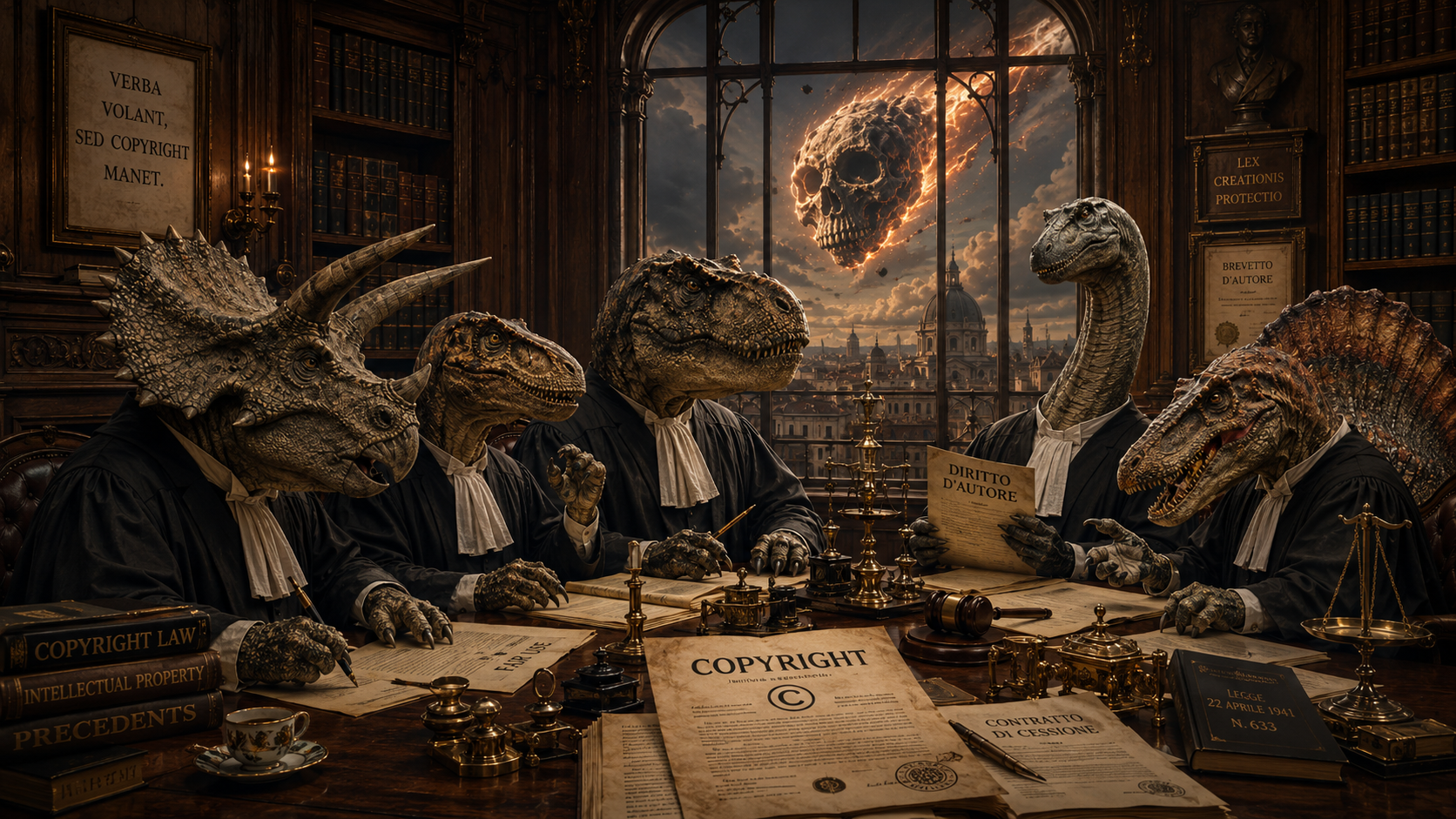
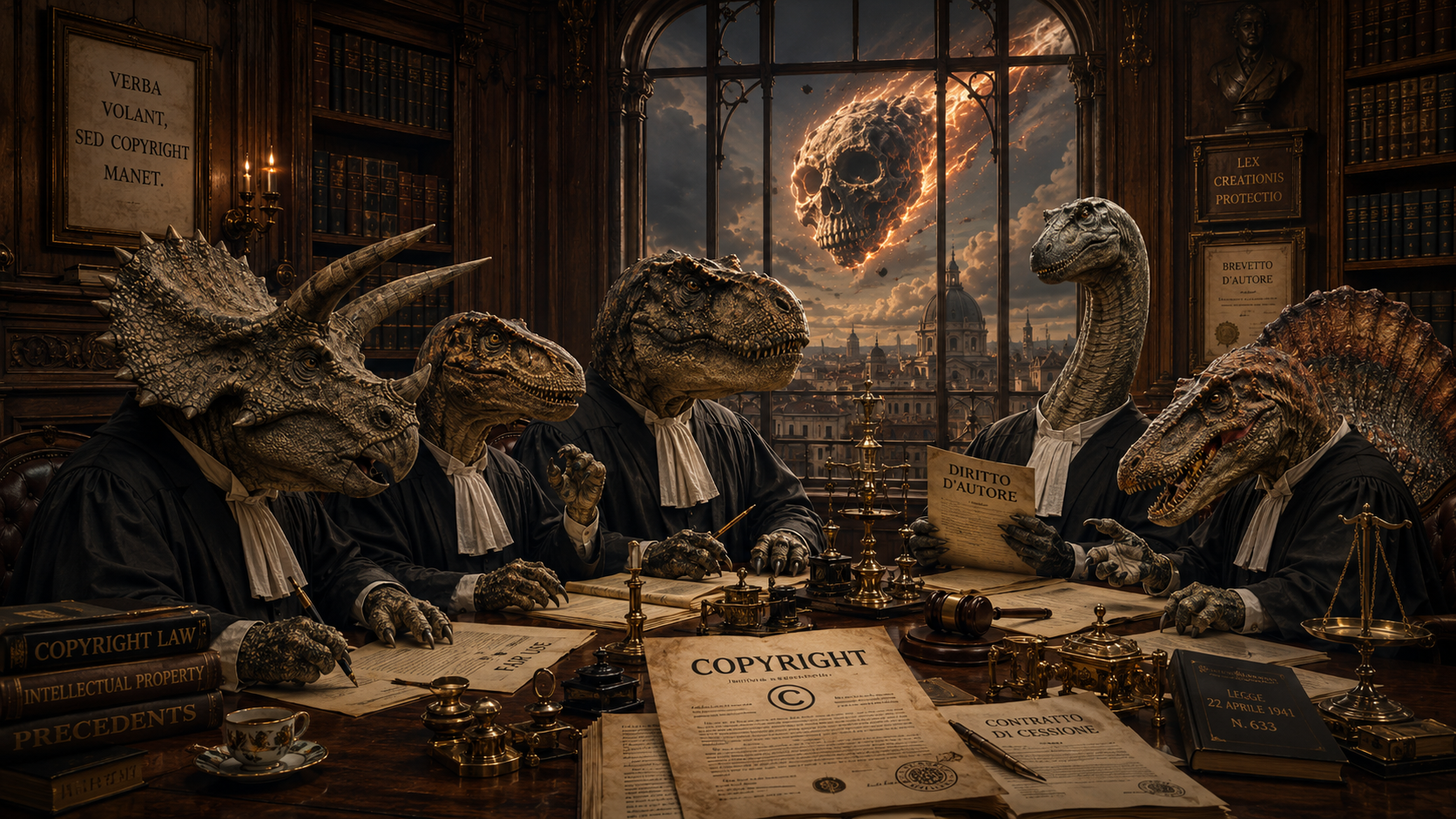
Either it is changed, with all due respect to SIAE, GEMA and the RIAA, or they will go the way of the dinosaurs. Perhaps they will continue to move for a while, enormous, noisy, convinced that they still dominate the plain, while the asteroid has already fallen and the climate has already changed.
And that is the good news.